
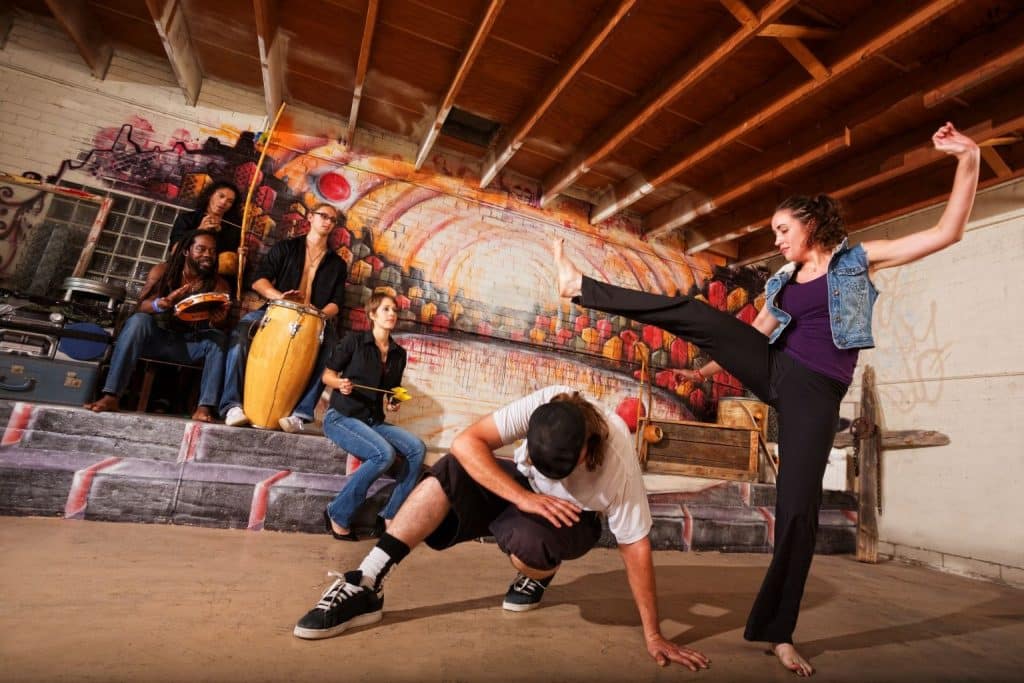
When young adults are struggling to engage in care or avoiding treatment altogether, it may be time to try something different. Growth doesn’t always happen sitting still, sometimes it begins with movement, music, and the fun of learning a new skill.
Capoeira, a form of Afro-Brazilian martial arts that incorporates acrobatics, dance, and rhythm, has become that opportunity for our community to find play in treatment. It provides a space for clients to express themselves and to engage outside the bounds of traditional treatment interventions. Unlike other martial art forms, participants play capoeira, incorporating movement and music into kicks and sweeps.
We sat down with Kim Cerbone, our full-time Health and Wellness specialist, who first introduced capoeira to The Dorm and has been training in this martial art for 15 years. Kim has made it her mission to bring the joy and healing power of movement to our community, and in leading this group has seen its impact in relieving stress, helping clients challenge perfectionism, and fostering meaningful new connections.
Key Article Takeways
Kim Cerbone: Capoeira is an Afro-Brazilian martial art that originated among enslaved people who were forbidden from fighting. To practice self-defense, they incorporated elements of dance into martial arts movements resulting in a blend of movement, acrobatics, and music.
- Rather than saying they “fight” capoeira, practitioners say they “play” capoeira to reflect the origins of this practice.
- There are a few styles of capoeira, including Angola and Regional, and many groups around the world practice their own variations. One of the most widely recognized groups is Abada Capoeira, which emphasizes the art’s blend of acrobatics, music, and cultural tradition.
- A typical capoeira session consists of training of the kicks, dodges and acrobats used in the roda (wheel). In the roda, or circle, participants sing, clap, and play traditional instruments while two people enter the center to play together through movement.
What inspired you to bring capoeira to The Dorm to support our young adults in treatment?
After training and teaching capoeira for many years, I’ve seen its impact in helping people build confidence and grow community. It felt like a perfect fit for our young adult population because at its heart, capoeira is deeply communal and importantly, accessible. Everyone can participate in different ways, whether through music, movement or play.
I’ll watch some participants enjoy playing with the movements, while others gravitate towards instruments or the rhythm work. One client might never do a kick, but they are just as part of the group as their peers. Showing up and engaging is what matters most. It very much embodies our individualized health and wellness approach of meeting someone exactly where they are that day. No matter how a client chooses to join our capoeira circle, they will feel involved and part of something special.
How does capoeira complement other therapeutic interventions?
Our treatment approach serves the whole person, including their physical wellbeing. So offering a range of groups and activities that incorporate functional movement, and that cultivate the mind-body connection is always going to be an important part of treatment alongside groups and clinical one-on-one therapy sessions.
We also never know what form of care will “open a door” for someone in their treatment journey. Sometimes we’ll see a client who is struggling with conventional treatment interventions or not contributing in groups. Perhaps it’s because they are new to our community and aren’t comfortable yet. Or perhaps they are feeling burnt out or like progress has plateaued. That’s when it’s important to be able to offer something new. Capoeira might just be that space where something can shift; where a client finally feels safe in community, or they discover something new about themselves. Often, these groups are the bridge to growth in other areas.
Do you or a loved one need help with mental health?
The Dorm is here.
What are the benefits of capoeira that you’ve seen among our young adult clients?
I work to create an affirming environment, where young adults can leave their self-consciousness and insecurities at the door. Our focus is on learning the art of capoeira and encouraging one another no matter their age, skills, diagnosis or abilities. Individuals who have never spoken before have an opportunity to work together and feel accomplished. The main clinical benefits I have seen are:
Self-discipline and personal accomplishment.
- In the beginning, playing capoeira may feel uncomfortable for young adults in the group – it’s a new skill and artform like any other! But through practice and a willingness to learn, I’ve seen how clients become excited to grow and improve. Capoeira invites you to push yourself, learn new skills, and grow over time. What makes it special is the way it balances challenge and joy. Most people leave their first class realizing it was harder than they expected, but also remembering how much fun they had. That combination of challenge, movement, and community is what keeps people coming back week after week. The learning process is never done, there is always something to work towards and improve.
A new opportunity for self-expression
- For individuals that may have trouble expressing themselves verbally, capoeira provides a new avenue to be themselves and experiment. Every client can benefit from this group but we often see individuals who are neurodiverse or navigating trauma drawn to this medium. Whether through playing an instrument, clapping, or doing dance or acrobatics, all clients have an important role to play.
Togetherness, community and groundedness
- One of the things I love most about this practice is how naturally it builds community. In every session, there is a strong sense of togetherness that can be felt in the room. People who may feel hesitant at first, eventually pick up an instrument and the rhythm and movement creates lightness and fun. Playing and learning together makes new connections feel possible for clients who may have never interacted before. In class, participants often pair up to practice, which encourages people who may not normally interact to connect and support each other. Over time, that shared experience creates a strong sense of belonging.
- I’ve also seen how therapeutic capoeira can be. The movement, music, and rhythm have a calming and grounding quality, and simply hearing the instruments can bring a sense of peace. That combination of play, creativity, and connection is what makes capoeira such a meaningful offering for our population.
What would you say to those who are interested in trying capoeira, but are not sure if it is right for them?
I always encourage everyone to simply try a class. Capoeira welcomes anyone interested at The Dorm, meaning that it is a multi-diagnostic, mixed milieu group. One client started capoeira with me who struggled with anxiety and body dysmorphia and had never engaged in movement before. Another was a student athlete who had a lot of pain and pressure attached to moving their body. No matter what the group is dealing with on the outside, in capoeira we come together as one community.
What do you hope participants take away from capoeira?
I hope individuals leave with a greater sense of confidence and self-acceptance. I also hope they take with them the understanding that growth comes from effort, not perfection. Whether it’s learning a new movement, playing an instrument, or encouraging a partner, those in the group begin to see that they are capable of more than they thought, and that feeling of confidence is something they can carry with them beyond the group.
As a fitness instructor, I incorporate play into everything I teach because that is how people learn best. I hope that individuals see that working hard and practicing can be fun and deeply rewarding. We always say that capoeira is for everyone and I hope they carry that mindset with them after the group and their time in treatment.
Health and Wellness at The Dorm
At The Dorm, we believe that integrating the mind and body through everyday functional movement helps young adults learn to connect with themselves and others. On average, our research shows an overall 134% improvement in client well-being. By integrating movement into our therapy programming, we provide young adults an alternative and powerful way to express and process their emotions and build community. Learn more about how The Dorm incorporates physical well-being through other modalities like Dance Movement Therapy (DMT).