
Liana was searching for support after her stay in residential treatment, looking to ease the transition from a higher level of care to her day to day life outside of treatment. The Dorm team connected with her while she was still at the residential treatment center, helping to facilitate the move while also motivating her to look forward to The Dorm community.
Diagnosed with OCD, Major Depressive Disorder (MDD), and chronic illness that contributed to her mental health symptoms, Liana hoped that The Dorm would be able to lessen her obsessive thoughts and compulsive behaviors, help her apply to and attend college, and participate more actively in her own life.
Treatment and Life Goals
After her time at the residential treatment center, Liana hoped to continue working on her existing goals as well as new ones, including:
- Reduce time spent in the obsession-compulsion cycle
- Become more comfortable with socializing
- Apply to and attend college, full-time
- Work on setting boundaries with her family
Treatment Plan and Recovery Journey
Individual Therapy & Clinical Coaching
Though therapy and coaching sessions were both provided, in Liana’s treatment plan, the content of those sessions were deeply intertwined. Some modalities that were used in both therapy and coaching sessions included:
- Exposure Response Prevention Therapy (ERP), a form of exposure therapy effective for individuals with OCD and OCD-related disorders, was a challenge that Liana was committed to working through. She was very motivated to try various exposures that would increase her social skills and tolerance of potential triggers.
- Acceptance and Commitment Therapy (ACT) is a modality to increase psychological flexibility, using acceptance and mindfulness strategies to help acknowledge the relationship between thoughts and feelings. For Liana, ACT helped her accept that her unwanted thoughts and feelings were just passing experiences, and also helped her to remember to focus on living according to her values despite her symptoms.
- Inference-Based Cognitive Behavioral Therapy (I-CBT) is an OCD-specific modality of CBT focusing on identifying and correcting maladaptive thought processes that may lead to the obsessive compulsive cycle. Liana’s team worked with her to understand and address the root causes of her obsessions, and how these lead to anxiety and compulsions.
- Radically Open Dialectical Behavioral Therapy (RO-DBT) helped Liana address her OCD-related rigid thinking, and helped her become more open in terms of emotional flexibility and social connectedness. This modality specifically truly complemented her goals in increasing her comfortability with socializing.
Parent Coaching and Family Therapy
Parent coaching sessions with Liana’s parents consisted mainly of identifying and reducing accommodating behaviors — behaviors that send a loved one with OCD deeper into the obsession-compulsion cycle. For Liana, her parents often provided reassurance around decisions to isolate and withdraw herself during moments of intense emotion, which, though well-intentioned, further reinforced her avoidance behaviors. Providing psychoeducation around these accommodating behaviors was a large part of family work, and over time helped Liana decrease her OCD symptoms.
Group Therapy
Group therapy acted almost as an exposure for Liana, providing her with opportunities to socialize while also working on decreasing symptoms and using therapeutic tools effectively. Some groups she found helpful were:
- OCD Group, which allowed Liana to accept that her OCD symptoms were normal — they weren’t something to be ashamed of. Accepting her symptoms was the first step to address and eventually reduce them, and this group was a major stepping stone in helping her understand that it was okay to talk about them.
- RO-DBT Group, an immensely helpful modality that was also employed during Liana’s individual sessions. Working with peers experiencing similar thinking patterns kept her accountable and actually using relevant skills in her daily life.
- Cooking Skills Group & Social Group, two groups that were also helpful in terms of exposure, helping Liana face her anxieties, and thus, over time, decreasing avoidance behaviors associated with OCD.
Liana’s Group Schedule
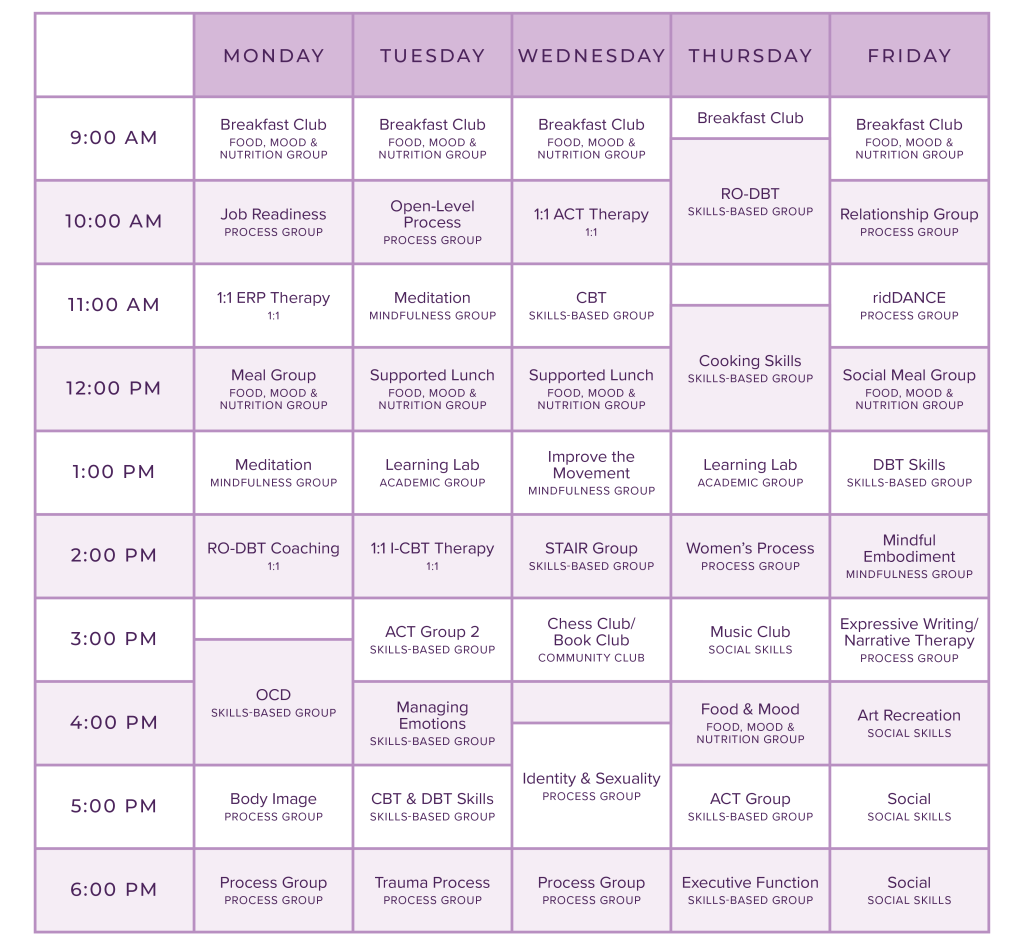
January 2026
Community Clubhouse
The Dorm’s Clubhouse and young adult community were crucial in Liana’s success.
The community model helped her address OCD-related social avoidance and compulsive rumination, forcing her into a mindfulness modality where she had to live in the present moment and not withdraw back into her own mind. Working with similarly-aged peers, with both similar and different diagnostic profiles as her, allowed Liana to envision what her own future could be in a real and tangible way – especially when she went off to college. The normalization and validation of experiences that she found at The Dorm were instrumental in allowing Liana to begin addressing her symptoms.
Academic, Careers and Vocational Support
During Liana’s gap year at The Dorm, she decided with her team to try to take a college level course as a “test trial” before going back to school full-time, which could also act as exposure for her OCD.
Simultaneously, Liana was also applying to various schools and received support from her team around managing application materials and deadlines. When she found success in her class and got into an undergraduate program, it increased her confidence and excitement about returning to school, affirming her ability to engage in academics and young adult life.
Liana Today: Outcomes
Today, Liana is thriving in her undergraduate program in design and holds a position at her religious institution. She continues to meet with an OCD-specific provider at an outpatient frequency to manage any obsessive thoughts or compulsive behaviors that may still occur, and receives treatment for her chronic illness.