

This post recaps a continuing education event hosted by The Dorm, in collaboration with Dr. Magenta Silberman, PhD. at the Huntsman Mental Health Institute.
Often unrecognized or misdiagnosed, somatic disorders incorporate both physical symptoms and underlying psychological distress. With a prevalence rate of 5-7% of the general population and growing, this issue is becoming increasingly relevant among young adults today.
Somatic disorders encompass a large range of diagnoses and symptoms, from illness anxiety disorder, where individuals experience excessive anxiety about their medical symptoms, to factitious disorder, where an individual intentionally creates symptoms in order to fulfill their internal desire of becoming a patient.
To help explain what could be behind this trend in young people, Dr. Magenta Silberman, PhD., of the Huntsman Mental Health Institute explains that in many cases, expressing physical discomfort may feel less vulnerable and more socially acceptable than expressing emotional distress, especially amidst ongoing mental health stigma. Dr. Silberman gives an example of what she’s seen in her experience, where “parents are generally more receptive when their child says ‘my stomach hurts,’ versus when they say ‘I’m sad’ — sometimes parents don’t know what to do with that. But they know they can make chicken soup when their child is not physically well.”
We were so grateful to have Dr. Silberman share with us her expertise on somatic disorders, how they relate to other psychiatric diagnoses, and effective treatment interventions.
Defining Somatic Disorders
Somatic disorders encompass a wide spectrum of diagnoses of various presentations:
- Illness anxiety disorder, previously “hypochondriasis,” involves a preoccupation with having or acquiring an illness. Individuals with anxiety disorder, for example, may not have somatic symptoms but are significantly distressed by the possibility of acquiring them.
- Somatic symptom disorder involves an excessive focus on one’s health and somatic symptoms. Individuals with this disorder usually do experience somatic symptoms and spend a significant amount of time and energy researching their health concerns and visiting doctors.
- Factitious disorder, formerly Munchausen syndrome, involves intentionally producing medical or psychiatric symptoms for the internal gain of being treated as a patient.
- Conversion disorder presents with serious neurologic symptoms, such as paralysis and seizures, in the absence of a neurological disease.
A complicating factor within all of the above diagnoses is the possibility of malingering, where an individual intentionally produces somatic symptoms for external gain, such as avoiding work or receiving compensation.
Assessing an individual’s distress, insight, subjective and objective experience of their symptoms, external and internal gain from their symptoms, and transparency about their symptoms is key to properly identifying and diagnosing a somatic disorder.
Case Example: Brian
Dr. Silberman shared an anonymized case study of someone who presented with somatic symptoms, and how she was able to distinguish his diagnosis based on his clinical symptomology.
Do you or a loved one need help with mental health?
The Dorm is here.
Childhood Development
Noted as “a chatty kid” with a “good temperament,” Brian presented with typical childhood development. He was diagnosed with ADHD at nine years old, but there were no notable markers of developmental impairment.
Transition to Somatic Symptoms
Brian’s family dynamic began to change after his younger sister was diagnosed with type-1 diabetes shortly following his own ADHD diagnosis. This, Dr. Silberman explains, began his fascination with medical equipment, such as asking for an IV pole as a Christmas present.
His family noticed that he began to not only show excessive interest in medicine but also in taking on the role of a patient. “His parents shared with me a time when he was in the hospital for this unexplained, intense abdominal pain,” Dr. Silberman says. “And they recalled him in the bed, blanket up, smiling ear to ear, just feeling so excited to be in the hospital, seeing the doctors running around trying to figure out what was happening to him… Slowly his identity morphed into somebody who was really ill.”
Transition to Young Adulthood
As Brian transitioned to young adulthood, he became increasingly involved in the medical field, attending nursing school and becoming familiar with medical information and lingo. After a doctor’s visit, he received opioids for his self-reported high levels of physical pain. Dr. Silberman explains that this began a shift from physical to psychiatric conditions, reporting episodes of mania, depression, and claims of being on the autism spectrum. Alongside an enmeshment with a substance use disorder, Brian also expressed a factitious urge to want to be in a hospital setting.
An additional factor was Brian’s lack of concern over his physical symptoms. Dr. Silberman reports that, while in treatment with the Huntsman Mental Health Institute, Brian received a diagnosis of having a mass in his lung. “What was really notable for us was that he wasn’t distressed.” Dr. Silberman shares. “I don’t know about you, but if I was told I had a mass on my lung, I’d be terrified. He was not worried. He was actually feeling quite curious, and shared with me that he had never seen an infectious disease in person before, and that he really wanted to know what that was like.”
So, What Was Brian’s Final Diagnosis?
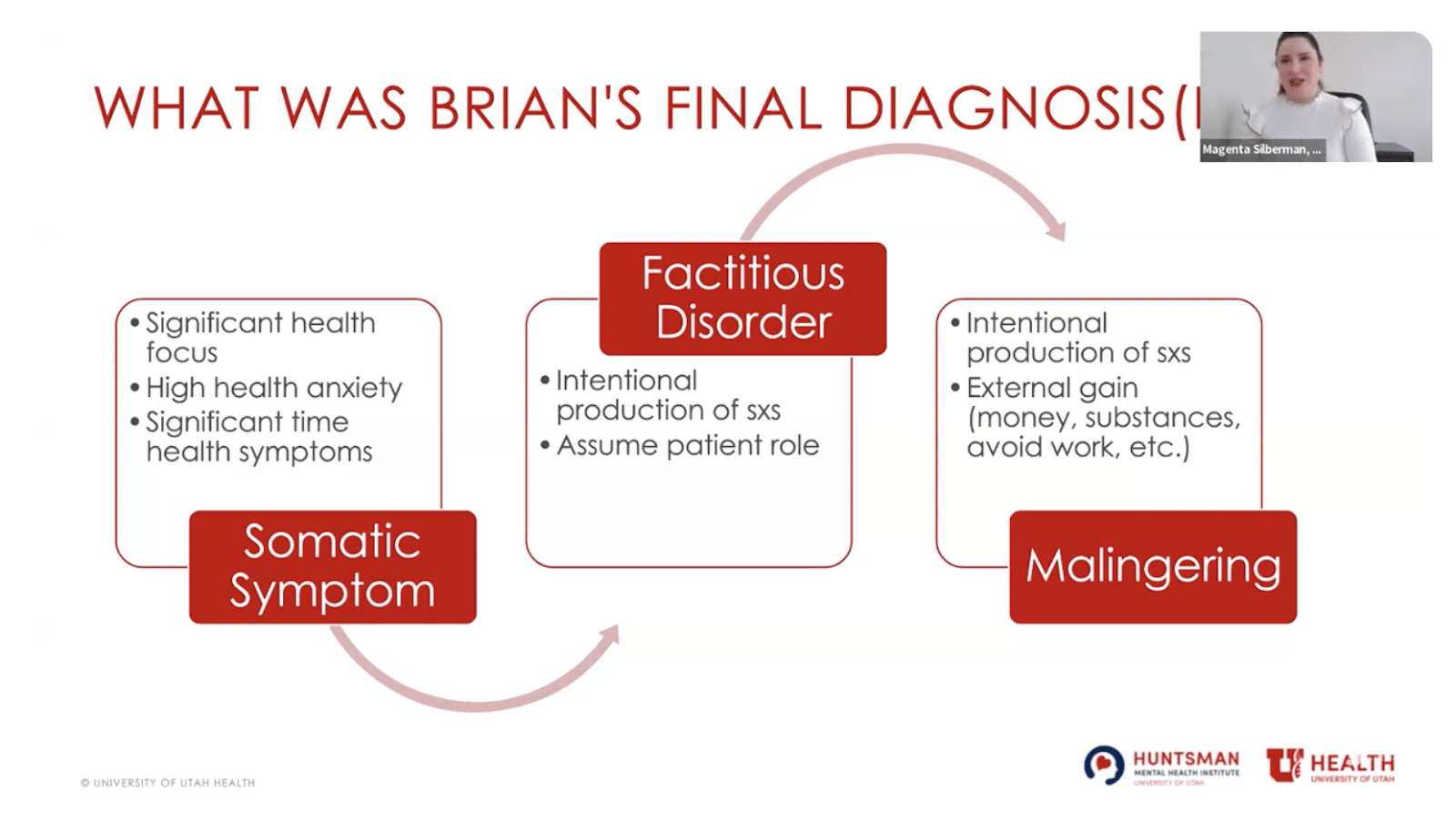
After careful observation, an exam of his history, and additional medical screenings, Dr. Silberman used the above screening process to land on multiple diagnoses for Brian, including factitious disorder with malingering, a substance use disorder, and a personality disorder, which helped forge his treatment plan and healing journey.
As Dr. Silberman continued to work with Brian, she noticed that he presented with some insight around his own disorder, which is not commonly seen in other individuals. Dr. Silberman shares, “What was really unique about Brian is he was aware that he had factitious disorder; however, he wasn’t present oriented. He would say, ‘yeah, that past stuff was factitious, but this is real. This is really happening.’ And we were able to do amazing therapeutic work with him to build his insight into how it was presenting in the current time.”
In Relation to Other Disorders
At The Dorm, 93% of our clients present with more than one diagnosis. Dr. Silberman finds a similar pattern in her clients with somatic disorders. When an individual experiences somatic symptoms, Dr. Silberman stresses the importance of conducting tests and screens for other factors such as trauma and personality disorders — diagnoses that often overlap with somatic disorders in nuanced ways.
Trauma & Somatic Disorders
In individuals diagnosed with somatic disorders, a co-occurring trauma diagnosis or past traumatic experience can lead to an exacerbation of somatic symptoms. Trauma also involves a physiological component, so even those without a formal somatic disorder diagnosis may still experience physical symptoms after a traumatic event. As Dr. Silberman shares, “I have seen cases where trauma responses can amplify that somatic symptom or preoccupation with health.”
Personality & Somatic Disorders
Similarly, those diagnosed with comorbid personality and somatic disorders may tend to exaggerate their physical symptoms as part of their emotional lability. Dr. Silberman describes a client who was also diagnosed with borderline personality disorder (BPD), who, in conjunction with her intense emotional experiences, would also express intense physical symptoms. Recognizing these patterns is an important part of overall treatment and highlights the interlinking of psychological distress and somatic symptoms.
Treatments For Somatic Symptom Disorders
Dr. Silberman introduces various modalities of psychotherapy as treatment for somatic disorders. Research in this field predominantly revolves around cognitive behavioral therapy (CBT) and motivational interviewing, two extensively studied modalities that focus on maladaptive thoughts and aim to reduce them.
Recent research also points to acceptance and commitment therapy (ACT) and dialectical behavioral therapy (DBT) as effective interventions, particularly for distress tolerance, coping skills, and managing health anxiety. Incorporating various relaxation and grounding techniques, such as mindfulness, has been found to be beneficial in Dr. Silberman’s own practice.
In addition to psychotherapy, interdisciplinary collaboration is also necessary for treatment of somatic disorders. Working with primary care physicians and psychiatrists, as well as coordinating communication between all parties, is key to sustaining a collaborative care environment.
Approaching treatment holistically through wellness and having a meaningful life outside of treatment is just as important as psychological and medical care. Dr. Silberman highlights a career or school, hobbies and passions, as well as familial, peer, and communal support as pillars of overall recovery.
We sincerely thank Dr. Silberman for furthering our understanding on such an interesting and increasingly relevant topic. Visit our YouTube to watch the full presentation.
About The Dorm
At The Dorm, our model features treatment tailored to each individual, support for the overall family system, and a community space for clients to create new friendships. With our approach, we have seen a 138% increase in well-being, which includes a greater acceptance of one’s symptoms and mental health condition, as well as improved overall quality of life. We offer a range of therapeutic groups, treating trauma, substance use disorders, personality disorders, and more in a multi-diagnostic milieu.
Learn more about our services and how we support clients in New York City and Washington D.C.