
At admission, Sloane presented with anxiety, an adjustment disorder, and depressed mood. She felt “lost” in her new college environment and overwhelmed by the relentless “hamster wheel” of assignments and finals. Summer was the perfect opportunity for her to step back from academic deadlines and focus on her personal growth and clinical needs.
Treatment and Life Goals
At The Dorm, Sloane was motivated to:
- Learn and apply coping skills to improve social/emotional functioning and better manage her anxiety and adjustment disorder
- Strengthen executive function skills such as time management and cognitive flexibility
- Work on interpersonal effectiveness skills with her friends and family
- Begin her sobriety journey
- Return to school in the fall
Treatment Schedule
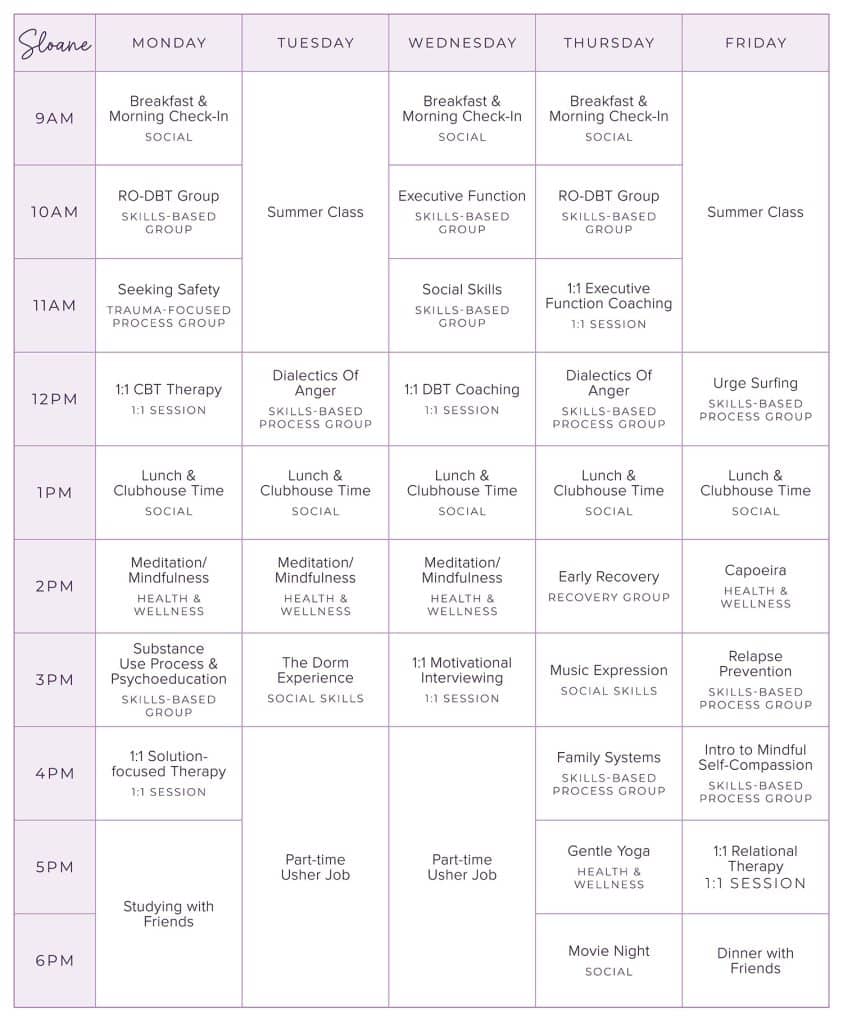
Treatment Plan and Recovery Journey
Individual Therapy
Sloane’s individual therapy sessions consisted of various modalities to address her anxiety and adjustment disorder:
- Cognitive Behavioral Therapy (CBT), which helped her challenge negative thought patterns. Often, Sloane would find herself spiraling due to her anxiety, specifically related to returning to school. She felt especially anxious about returning to a place associated with previous negative experiences, and worked closely with her treatment team to learn how to catch herself before falling into an anxious spiral.
- Motivational Interviewing, to keep her engaged in treatment and motivated to pursue her goal of returning to university for her fall semester.
- Solution-Focused Therapy, in which her therapist would work with her to create tangible and achievable steps towards her goals.
- Relational Therapy, to focus on her relationships with others and consider how they might affect her own mental health and overall wellness.
Clinical Coaching
- In clinical coaching, Sloane’s was focused on building day-to-day executive functioning skills, including planning and organizing her schedule outside of treatment. This helped her feel more capable and confident in managing multiple commitments (essential for a rising sophomore).
- Sloane also worked with her coach to learn various Dialectical Behavioral Therapy (DBT) skills to help her cope with her anxiety symptoms and depressed moods, as well as learn how to effectively communicate with others. One such skill was the DEARMAN skill, which helped Sloane better set boundaries, communicate her needs, and work through conflict.
Parent Coaching and Family Therapy
Sloane’s family was actively involved in parent coaching sessions, where they learned how to better express their concerns in a more productive and supportive way. They also took part in weekly Parent DBT Skills Group sessions, where they were able to build core DBT skills like distress tolerance and interpersonal effectiveness alongside Sloane. Developing a shared language proved helpful in strengthening their ongoing communication.
Group Therapy
Sloane was very active in group therapy sessions, especially toward the end of her treatment journey when she was able to provide feedback and insight to other clients struggling with similar experiences. A few groups Sloane enjoyed were:
- RO-DBT Group, a version of DBT focused on increasing the flexibility of thought and emotions. This group helped Sloane be more open with herself and others, improving her relationship with her family as well as new and existing friends.
- Executive Function Group: Sloane benefited from developing the skills needed to plan, initiate, organize and execute tasks as well as cope with transitions and regulate emotional responses.
- Urge Surfing Group, assisted Sloane through her substance cravings with other individuals working through both similar and different urges.
- Relapse Prevention & Early Recovery Groups, where Sloane was able to work toward sobriety with the support of peers navigating their sobriety journeys.
Academic, Careers and Vocational Support
- Sloane was determined to return to school for her fall semester. Alongside her treatment team, Sloane made the decision early in her treatment journey to take a summer class as a “stress test” before returning to school in the fall. Sloane found herself excelling in her summer course, which helped her realize that she could engage in academics without turning to negative coping mechanisms. Her summer classes acted as a great transition back to full-time school, boosting Sloane’s confidence in herself and her abilities.
- Additionally, Sloane held a part-time position as an usher for a major event. Over the summer, she learned to balance her academics, job, mental health treatment, and overall wellness successfully, building the skills necessary for managing college stressors like juggling various academic courses and effective communication with peers and professors.
Community Clubhouse
- Community was an enriching aspect of Sloane’s Dorm experience. She leaned on The Dorm community while engaged in summer classes, building a strong support network that continues to this day. Learning to connect with other clients played a significant role in increasing her confidence to return to school full-time, and having a sober space was helpful for her sobriety journey.
- Sloane stayed involved with The Dorm even after returning to school in the fall. She continued to receive support at an outpatient level as a full-time student, helping her with the transition back to her academic and independent life.
Sloane Today: Outcomes
Today, Sloane is thriving as a full-time sophomore studying journalism. She’s active in campus life and has formed strong new friendships, helping her redefine her university experience and move beyond past negative associations. Sloane continues to remain sober, is still in touch with the friends she made at The Dorm, and consistently meets with an outside therapist to maintain mental wellness.