
Savannah arrived at The Dorm after struggling with suicidal ideation and multiple mental health diagnoses including PTSD, BPD, and OCD. Borderline Personality Disorder (BPD), in particular, meant that she struggled with her identity and turned to harmful coping mechanisms when in distress. She had recently started college and struggled to maintain her mental health and meet new people. Over the past few years, Savannah had been hospitalized a few times, and needed more care than was available in other treatments settings. With the coordinated care available at The Dorm, she started treatment with hopes of better managing her trauma and learning to communicate her needs.
Treatment and Life Goals
- Finding stability
- Effective communication
- Learning how to manage big emotions
- Re-engaging with others despite fear
Treatment Plan and Recovery Journey
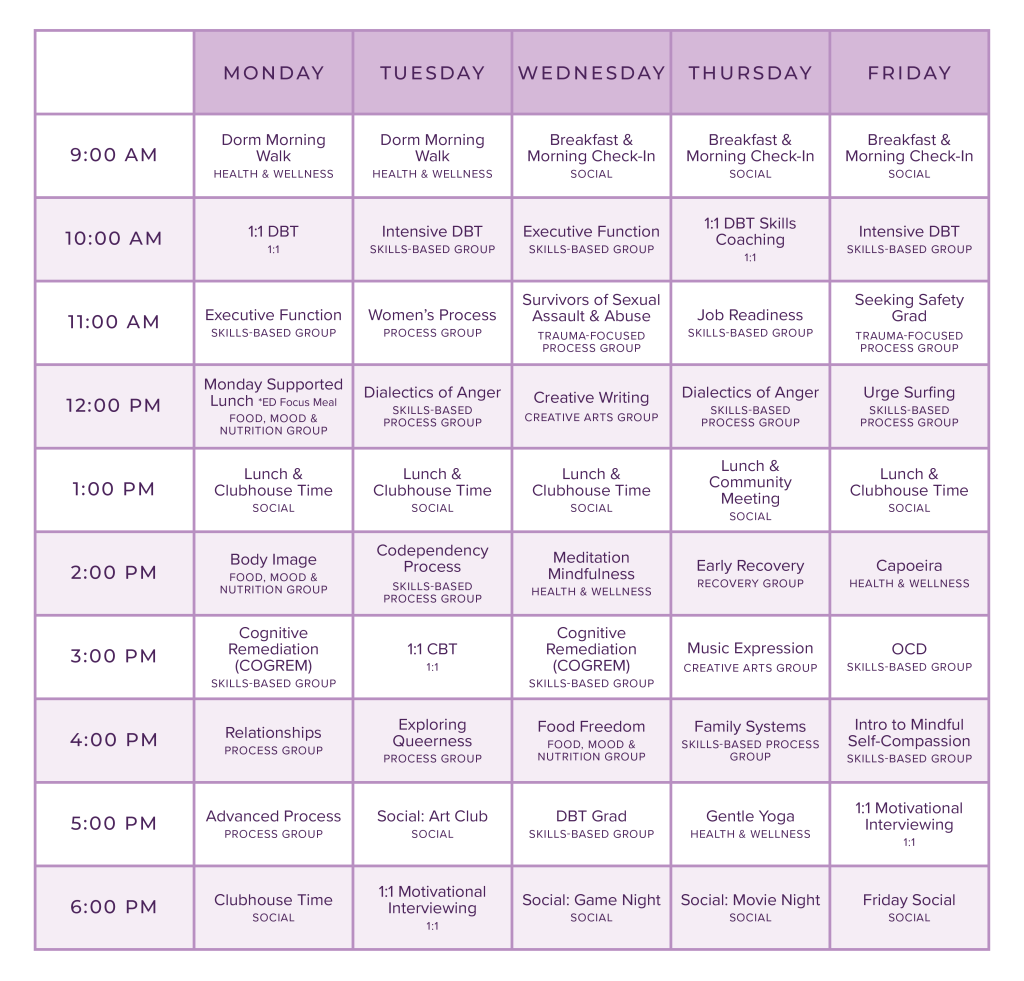
Dialectical Behavioral Therapy (DBT) played a central role in Savannah’s journey to find equilibrium. Specifically designed to treat Borderline Personality Disorder (BPD), DBT equipped her with tools to regulate intense emotions, form boundaries, and navigate relationships with greater confidence. As Savannah practiced these skills, she felt more grounded in her day-to-day life and interactions with peers.
Cognitive Behavioral Therapy (CBT) helped Savannah explore the connection between her thoughts, feelings, and behaviors. With this insight, she became better able to notice unhelpful patterns as they emerged and respond with greater awareness and intention.
Motivational Interviewing created a safe, supportive space where Savannah felt comfortable setting goals and sharing past experiences. Through a collaborative approach with her therapist and coach, Savannah strengthened her motivation to move forward in her recovery.
Community Engagement
Savannah thrived in The Dorm community clubhouse, calling the space her “safe-haven.” She could be found introducing herself at morning check in, relaxing in between process groups, and getting to know other clients. A familiar face to all at The Dorm, as Savannah became more confident in herself throughout treatment, she fully engaged with The Dorm community.
Outcomes
Today, Savannah completed her college degree and is working full-time at a public school. She never imagined that living an independent, well-rounded life was possible for her. Even though her journey has not been linear, she is now able to manage her emotions and tolerate difficult situations as they arise using skills she learned while in treatment. Because of her experience at The Dorm, she also knows what it means to feel belonging and safety in community. As she forges on her own path, she remembers the community that supported her and the feeling of having a safe space.